
How to Read a Nitric Acid Safety Data Sheet and Match It to the Container
Start with the container label. To read a nitric acid safety data sheet (SDS), match the supplier, product identifier and stated concentration to sections 1 and 3. Then read section 2 for the hazards of that product. The Fisher Scientific example below follows two bottles with the same chemical name and shows why only one of them can be matched to the sheet.
Does this sheet belong to the container in front of you?
Suppose two stockroom bottles are labelled “nitric acid” and someone has emailed you a PDF. Copy the first bottle’s product name, supplier and catalogue code exactly as printed. Include any concentration with its unit and the grade as stated. Look for the product name and code in section 1. A single sheet can cover several package codes, so check the catalogue list if yours is missing from the file title. Compare any concentration on the label with the composition reported in section 3. OSHA’s identification and composition requirements for a US SDS
Nitric acid has the chemical identifier CAS 7697-37-2. You may also find it among the ingredients of a formulated cleaner. To understand the hazards of the mixture in that container, ask for the finished cleaner’s sheet. This distinction matters when choosing a product for cleaning in the dairy industry. Nitric acid in the NIOSH Pocket Guide
Reading a real nitric acid SDS from Fisher Scientific
Open Fisher Scientific’s US safety data sheet for nitric acid. This example uses revision 14. There are two things you need to establish. Does this sheet describe the product on the label? Could another reader retrieve the edition you used?
Which numbers identify the product and the document?
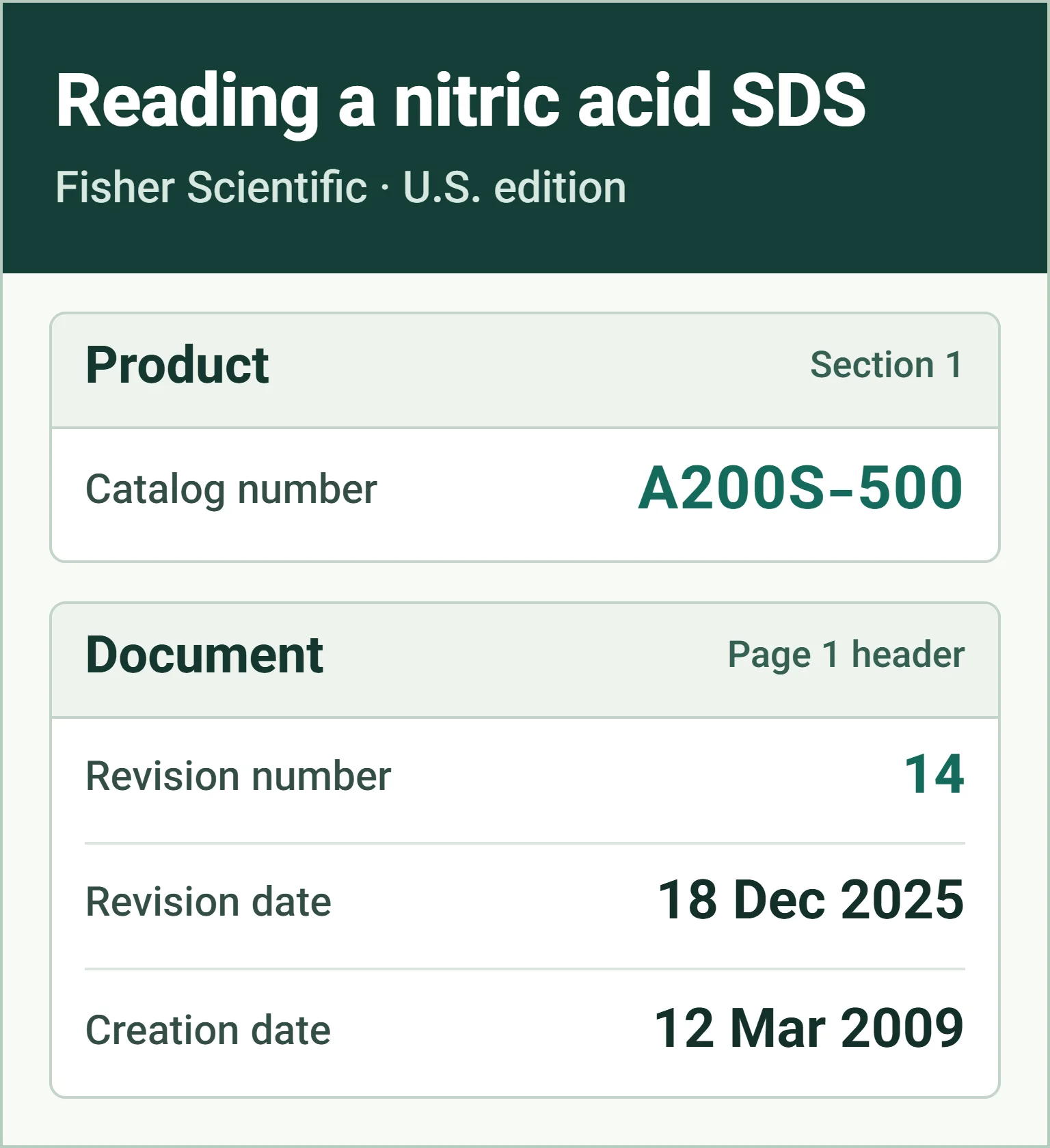
On page 1, find the catalogue numbers in section 1. A200S-500 identifies one of the products covered. Now look at the header on the same page. The number 14 identifies the revision. March 12, 2009 is the creation date, while December 18, 2025 is the date of the revision used here. The diagram groups these fields by what they identify. Keep a dated copy of the PDF or an archive reference, since a supplier link can lead to a later edition.
| Where to look | What this sheet reports | What you can conclude |
|---|---|---|
| Section 1, identification | A200S-500 is one of the catalogue codes listed. | Check the supplier and product name on the label as well. One sheet can cover several package codes. |
| Section 3, ingredients | The nitric acid entry gives a range of 65–70% by weight. | Keep both ends of the range and the weight basis. The exact concentration of an individual lot cannot be determined from this entry. |
| Section 2, hazards | The signal word is “Danger”. The product is classified as an oxidizing liquid. The sheet also reports severe skin burns, eye damage and toxicity by inhalation. | Read the individual statements to find the routes of harm. The signal word alone does not identify them. |
| First page and section 16, document history | The first page gives revision 14. Section 16 repeats the December 18, 2025 revision date. | Save the revision alongside the file link so the finding can be checked against the same edition. |
What should you record for each bottle?
First bottle. Suppose the label reads “Fisher Scientific”, “A200S-500” and “Nitric acid (65–70%)”. Those entries match the worked example. Record the code, the section 3 range of 65–70% by weight and revision 14 with your copy of the PDF. If the quality team needs a result for this particular lot, copy the lot number from the bottle and ask the supplier for the corresponding certificate of analysis.
Second bottle. Only the words “nitric acid” are legible. Record “match unconfirmed” and put the container on hold while the site safety lead establishes its identity and obtains the applicable sheet. Copying the first bottle’s code, composition or hazard classification into the second record would turn a gap in the evidence into a false match.
Which SDS section answers your question?
Locate the information you may need while becoming familiar with the product, before an incident occurs. The table maps common questions to the 16-section format. Emergency contacts and regulatory requirements can vary with the market the sheet was prepared for. OSHA’s Hazard Communication Standard, Appendix D and the Canadian Centre for Occupational Health and Safety’s guide to safety data sheets
| Reader’s question | Section | What to look for |
|---|---|---|
| Where is the immediate response information for an exposure? | 4 and 1 | In section 4, find the relevant route, such as eye contact or inhalation. Section 1 gives the supplier’s emergency contact. In an actual incident, activate the site’s emergency plan immediately. |
| Where should a response team look for a fire or a spill? | 5 and 6 | Section 5 covers fire. Section 6 covers accidental releases. Identify the event clearly when reporting it. |
| What should the team check before work or storage? | 7, 8 and 10 | Use section 7 for handling and storage, section 8 for exposure controls and personal protection, and section 10 for incompatibilities. |
| Where are physical properties and reported health effects? | 9 and 11 | Read each property with its units and conditions in section 9. Section 11 describes exposure routes and immediate or delayed effects. |
| Where do environmental, disposal, transport and regulatory questions belong? | 12 to 15 | These four sections address those topics in that order. Check the jurisdiction before using an entry for a local decision. |
How should you interpret a percentage, an exposure limit or a missing value?
Before entering a value in a register, read the row heading, units and qualification together. A number may describe the liquid in the bottle or the air a worker breathes. When the supplier gives no number, the words in its place matter just as much.
How does a composition range differ from an airborne exposure limit?
The 65–70% range in section 3 gives the fraction of the solution’s mass contributed by nitric acid. In section 8, a value in ppm or mg/m³ may describe an occupational limit for airborne exposure over a stated period. When quoting a limit, record the issuing authority, units and time period with it. The percentage on the bottle cannot tell you the concentration in the air at a worker’s position. NIOSH entry for nitric acid and NIOSH guide to exposure-limit terms and units
How should you record the odour threshold and particle characteristics?
On page 5, section 9 of the Fisher sheet gives no reported odour threshold. In the row for particle characteristics it explains that the property does not apply to a liquid. Preserve those two explanations when you enter the data in a register. A zero in either cell could be mistaken for a measurement, giving the next reader a result that the supplier never reported. Fisher SDS, section 9, physical and chemical properties
What if two versions of a sheet disagree?
First compare the supplier, product code, concentration and intended market. When these match, confirm the current version with the supplier and mark which edition your team is using. A later date on a sheet prepared for a different product or market leaves the original question open. Send the site safety lead or supplier the legible details from the label and the revision identifiers from both files.
A handover should let the next person resume the check. Record the container identifier, supplier, document revision, section supporting the answer and any unresolved discrepancy. Once the product is identified, the safety lead can use the sheet alongside the actual working conditions, including ventilation and the likelihood of exposure, to assess the task. UK Health and Safety Executive guidance on using an SDS in risk assessment
Sources and editions
The English text and diagram were prepared with assistance from Codex (OpenAI). The market and revision cited in the example refer to the Fisher sheet. Sources were checked on November 25, 2026.
- Fisher Scientific, US nitric acid safety data sheet, revision 14, December 18, 2025. The worked example uses sections 1, 2, 3, 9 and 16.
- US Occupational Safety and Health Administration, 29 CFR 1910.1200, Appendix D, table of SDS section contents.
- Canadian Centre for Occupational Health and Safety, WHMIS guide to safety data sheets.
- US National Institute for Occupational Safety and Health, Pocket Guide entry for nitric acid, reviewed October 30, 2019.
- NIOSH Pocket Guide introduction, exposure-limit conventions and units.
- UK Health and Safety Executive, Chemical safety data sheets, on workplace risk assessment.
Original images and alternate sizes
Cover illustration
PNG (2400 × 1800) · 16:9 (1600 × 900) · 4:3 (1600 × 1200) · 1:1 (1200 × 1200)
Fisher SDS reading diagram
PNG (1536 × 1680) · 16:9 (1600 × 900) · 4:3 (1600 × 1200) · 1:1 (1200 × 1200)





Submit a comment
Comments
IranChem editorial team · sample question
Section 3 of the Fisher sheet gives a range of 65–70% by weight. If the quality team needs the measured value for this particular lot, which identifier from the bottle should accompany the request for a certificate of analysis?
IranChem editorial team · sample question
In section 9, there is no value for the odour threshold, while the particle characteristics entry says the property does not apply to a liquid. How should those entries appear in a register?
Site administrator
Sample editorial reply — For the odour threshold, record “no information reported in the sheet.” For particle characteristics, record “not applicable to this liquid.” Entering zero in either field could make it look like someone measured the property.
IranChem editorial team · sample question
The first page of the Fisher sheet lists both March 12, 2009 and December 18, 2025. Which date should go next to the revision number so a colleague can find the same edition?
Site administrator
Sample editorial reply — For the sheet used in the article, record “revision 14, December 18, 2025.” March 12, 2009 is the original creation date. Keep a copy of that PDF with the record, since the supplier’s link may point to a newer edition later.